
Small applications typically run in a moderate budget range, mid-sized business systems cost more, and enterprise platforms are significantly higher. That build price is only half the story: annual maintenance usually adds a substantial percentage of the original cost, every year the system runs. Before you commission anything, we urge you to compare total cost of ownership, not just the headline quote, and to get a scoped estimate from a bespoke software provider rather than guess.
TL;DR:
- Total cost of ownership includes ongoing maintenance costs of 15-20% annually, which can equal or surpass the original build after several years.
- Project scope, especially feature complexity, integrations, and data migration, significantly influences the initial quote, with ambiguity causing large bid variations.
- Mid-sized applications typically require several months to build, with cost drivers including multiple integrations, user roles, and custom reporting features.
- Onshore teams have higher hourly rates but reduce rework and speed up feedback, while offshore teams are cheaper but risk increased delays and scope misunderstandings.
- A detailed scope and discovery process help secure a fixed-price quote, avoiding cost overruns caused by unclear requirements or scope creep.
Table of Contents
- How much does custom software cost by project size?
- What actually drives the cost of custom software?
- How is a software budget split across project phases?
- How much do team location and model affect the final cost?
- How do you build a first-phase cost estimate yourself?
- What does custom software really cost over three to five years?
- How do you get a credible custom software quote?
- How Rockmountai scopes projects to control cost
- Why discovery beats guesswork every time
- Get a scoped quote instead of a rough estimate
- Sources
How much does custom software cost by project size?
Your budget depends almost entirely on where your project sits on the complexity scale, and most quotes fall into three recognisable bands.
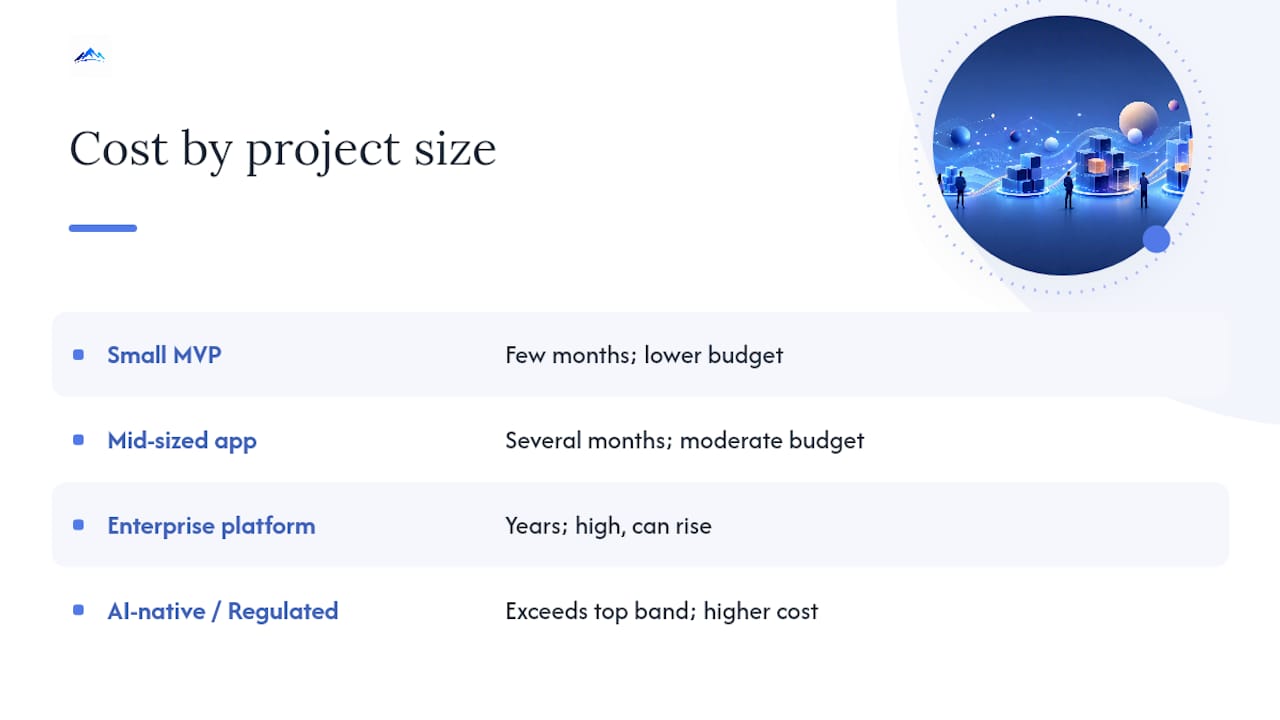
Small applications or MVPs typically fall within a common lower budget range. This covers a single core workflow, limited third-party integrations, and a lean feature set built for one user type. Expect a timeline of a few months. It's the right band for testing an idea, replacing a spreadsheet-based process, or automating one specific bottleneck.
Mid-sized business applications fall into a moderate budget range. Here you're paying for multiple user roles, several integrations (payment gateways, CRM, accounting software), custom reporting, and often a mobile companion app. Build time stretches over several months because the scope genuinely is bigger. Most established businesses commissioning their first proper piece of bespoke software land here.
Enterprise platforms start from a high budget range and can run substantially higher according to current planning bands for 2026. These projects involve high-assurance requirements, phased delivery across multiple teams, and delivery timelines measured in years rather than months.
A fourth category deserves a mention: AI-native builds and anything touching regulated data (healthcare, finance, legal) routinely push past the top of their expected band. Machine learning components need data pipelines, model training, and ongoing retraining budgets that a standard workflow app never touches. Compliance certification adds its own separate cost, which we'll cover later. If your brief includes either of these, treat the upper range as your starting point, not your ceiling.
What actually drives the cost of custom software?
Six variables move a quote more than anything else, and most of them are hidden until you've had a proper scoping conversation.
- Feature count and complexity — a login screen costs little; a permissions system with five user roles, audit trails, and approval workflows costs a great deal more.
- Integrations — every third-party system you connect to (Xero, Salesforce, a legacy database) adds effort that's genuinely hard to estimate until someone has looked at that system's API.
- Data migration — moving records out of an old system is consistently underestimated. Dirty data, inconsistent formats, and missing fields turn a "simple export" into weeks of cleanup work.
- Design and UX — customer-facing applications need far more design polish than internal tools, and that shows up directly in the invoice.
- Security and compliance — encryption standards, access controls, and audit logging add fixed overhead regardless of how simple the rest of the app is.
- Testing and release model — continuous delivery with automated testing costs more upfront but less in the long run than a single "big bang" launch with manual QA.
Pro Tip: Ask any vendor to price your feature list twice, once with your "must-haves" only and once with everything you'd like. The gap between those two numbers usually reveals which features are genuinely driving cost, rather than just adding polish.
Scope ambiguity is the single biggest cause of quote variation. One industry write-up found the same brief produced bids that varied eightfold between vendors, purely because the feature list wasn't pinned down before pricing began.
How is a software budget split across project phases?
Once you know your rough band, the next useful question is where that money actually goes. Most well-run projects follow a similar phase split, regardless of overall size.
| Phase | Typical share of budget |
|---|---|
| Discovery | about a tenth |
| Design and UX | roughly a sixth to a fifth |
| Engineering | about half |
| QA and testing | roughly a tenth |
| Integrations and deployment | a smaller share |
These proportions come from phase allocation data used across current market guides. For a mid-sized project, this means money is spread across these phases with an additional contingency slice to add on top.
That contingency line matters more than most first-time buyers assume. Projects that skip a formal discovery phase, or that don't hold back a contingency reserve, are far more prone to costly mid-project change orders, according to project contingency guidance from Tempo. Discovery is an important phase that helps prevent the other phases from running over budget.
How much do team location and model affect the final cost?
Hourly rates vary enormously by where your development team sits, and the cheapest rate on paper isn't always the cheapest delivered cost.
Clutch's aggregated pricing data shows verified project costs averaging in the low six figures with timelines of about a year, but the spread beneath that average is wide, driven mostly by region and provider class rather than project complexity alone.
- Onshore teams carry the highest hourly rates but the lowest communication overhead and the fastest feedback loops.
- Nearshore teams (similar time zone, lower cost base) often deliver the best balance of price and delivery speed for UK businesses.
- Offshore teams offer the lowest headline rate but can lose those savings to rework, time-zone lag, and slower iteration on ambiguous requirements.
- Hybrid models, pairing onshore leadership and architecture with nearshore or offshore engineering capacity, are increasingly common because they keep decision-making close while controlling the blended rate.
A lower hourly rate only helps your budget if it doesn't cost you three extra rounds of rework to get the feature right. Blended rate, not headline rate, is what determines your real delivered cost.
How do you build a first-phase cost estimate yourself?
You don't need a finance degree to build a defensible first-pass estimate. A spreadsheet and an hour of honest scoping will get you close enough to sanity-check any vendor quote.
- List your core features in plain language. Separate "must-have for launch" from "nice to have later."
- Count your integrations. Each connection to an external system (payment provider, CRM, accounting tool) is a separate line, not an afterthought.
- Estimate role-hours per feature. Rough figures are fine at this stage: a design hour, a build hour, a QA hour for each feature.
- Choose your team model (onshore, nearshore, offshore, or hybrid) based on the trade-offs above.
- Apply a blended hourly rate appropriate to that model, then multiply by total estimated hours.
- Add discovery and contingency. Ten percent for discovery and a further contingency buffer, commonly 15 to 20%, protects you against scope creep.
- Layer on maintenance. Multiply your build total by 15 to 20% to get your first year of ongoing cost, then repeat for a multi-year view.
Pro Tip: Run this spreadsheet twice, once with your integration count doubled. If your total barely moves, integrations aren't your risk. If it jumps sharply, that's the input a vendor needs to nail down before you sign anything.
What does custom software really cost over three to five years?
The build price is the smallest number you'll ever pay for this system. Budget 15–20% of your original build cost annually for maintenance, patches, security updates and small feature refinements, a benchmark that holds across most current industry cost guidance, with regulated systems often running higher.
On a £100,000 mid-sized build, expect roughly £15,000–£20,000 in maintenance per year. Over three years, total cost of ownership lands near £145,000–£160,000. Over five years, it climbs to £175,000–£200,000, meaning maintenance alone can approach or exceed the original build spend.
Hosting, third-party licence renewals, and support SLAs sit on top of that maintenance figure and vary by project. A system with heavy third-party API dependence will carry ongoing licence costs that a fully self-contained application won't. Ask any vendor to itemise these separately rather than folding them into a vague "support" line.
How do you get a credible custom software quote?
A trustworthy proposal reads like a contract, not a sales pitch. Before you sign anything, check that it includes the following.
- A detailed scope document listing every feature, not a one-line description.
- Milestones tied to payment, with clear acceptance criteria for each one.
- Explicit intellectual property terms confirming you own the finished code outright.
- A stated maintenance and support structure with response times.
- A named team composition, including seniority levels, not just "our developers."
Ask vendors directly about test coverage, warranty periods on defects found post-launch, and exactly what a full handover includes. A credible partner should welcome these questions rather than deflect them.
Watch for red flags: a quote with no discovery phase, no contingency line, or a team composition described only in vague terms ("our expert team will handle this"). These are the proposals most likely to balloon in cost once the real work starts.
How Rockmountai scopes projects to control cost
Engagements typically begin with a hands-on discovery phase: analysing your existing systems, mapping inefficiencies, and proposing automation tailored to your actual workflow rather than a generic template. That process, paired with direct client involvement from consultation through handover, is what turns a rough budget band into a scoped, fixed-price proposal you can hold a vendor to.
Why discovery beats guesswork every time
The biggest budgeting mistake we see isn't picking the wrong price band. It's skipping the step that would have told you which band you're actually in. A short discovery engagement costs a fraction of the build and removes most of the guesswork that turns a £60,000 project into a £95,000 one.
Our recommendation is simple: don't commit to a full build quote until someone has scoped your actual requirements against your actual systems. Request a discovery conversation before you request a final price.
— rocky
Get a scoped quote instead of a rough estimate
Everything in this article gives you planning bands. What it can't give you is your number, because that depends on your integrations, your data, and your compliance needs. A hands-on discovery engagement can turn a wide market range into a fixed-price proposal you can actually plan around, with no long-term dependency on the provider once the build is handed over.
We work with small business owners, marketing teams, and operational leads who need a real-time data platform, a bespoke SaaS tool, or an AI automation system that fits how they already work, not a generic package. The process starts with us analysing your existing setup and proposing a solution addressed to your specific bottleneck, priced and scoped before anything gets built. If you've got a rough idea of your budget band from this article and want to know exactly where your project sits, get in touch with Rockmountai to request a discovery engagement.
This article is general information, not a substitute for advice from a qualified financial advisor. Consult a qualified financial professional about your own circumstances before acting on anything here.