
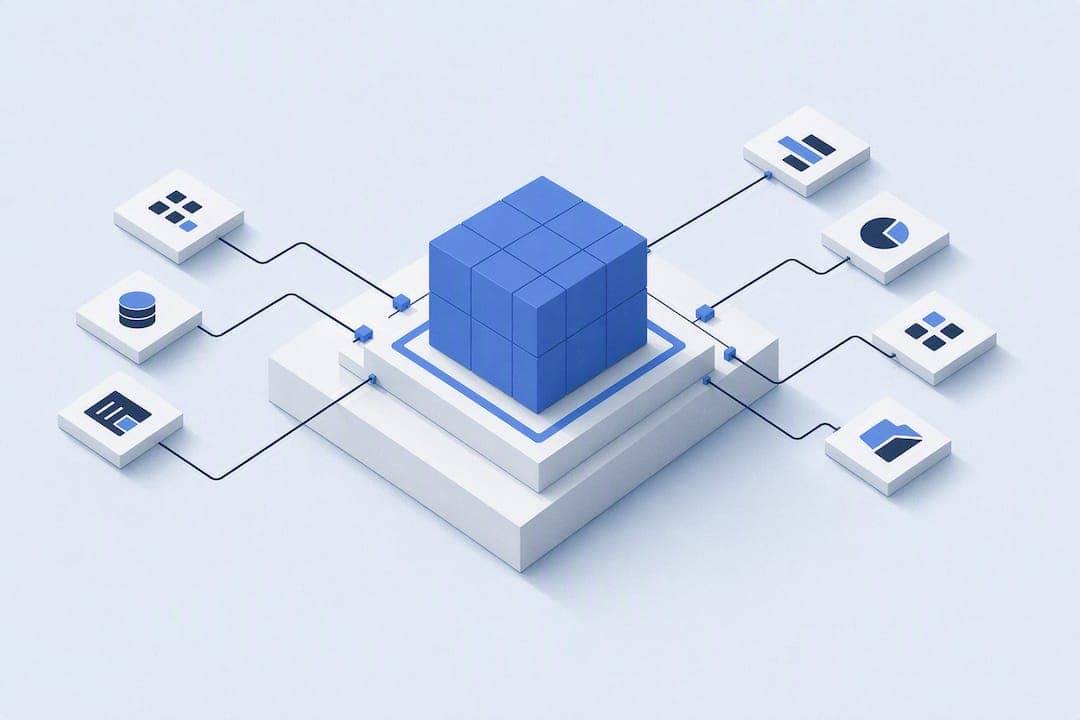
A single source of truth (SSOT) is the one authoritative place where a given piece of data is created, owned, and updated, so every other system reads a copy rather than a competing version. The main payoff is consistency: reports, dashboards, and applications stop disagreeing with each other. The first move for any leader is not buying a platform. It's naming the canonical schema and the master domain owner before a single line of integration code gets written.
TL;DR:
- A true SSOT requires explicit ownership, governance, and a clearly defined canonical schema, which are often overlooked in favor of technical implementation.
- Building an SSOT should be a phased process beginning with defining scope, choosing the implementation, and establishing robust reconciliation and validation methods.
- Maintaining ongoing data integrity involves role-based access control, change management, automated audits, and active stewardship to prevent drift and ensure trustworthiness.
- An SSOT is most effective for core master data, event sourcing, or schema-based API synchronization; it often isn't feasible for highly distributed, latency-sensitive systems.
- Security risks increase as the SSOT concentrates sensitive data, necessitating strict access controls, encryption, and comprehensive audit logs to guard against breaches and regulatory issues.
Table of Contents
- What is a single source of truth (and what it isn't)
- Architectural patterns that realise a single source of truth
- When a true SSOT is feasible, and when it isn't
- How do you actually build a single source of truth?
- Governance, DataOps, and keeping data integrity intact
- Where does SSOT actually pay off?
- Security and privacy considerations when implementing SSOT
- Why culture, not code, decides whether SSOT sticks
- How Rockmountai approaches single source of truth projects
- How Rockmountai can help you build one
- Sources
What is a single source of truth (and what it isn't)
A single source of truth is a formal architectural principle, not a slogan for "our main database." It means every data element, a customer's address, an order's status, a product's price, is mastered, edited, and stored in exactly one authoritative location. Everything else consuming that data holds a reference or a copy, never a competing original.
People often conflate SSOT with a single version of the truth (SVOT). They're related but distinct. An SSOT governs where data is created and edited. An SVOT is about where data is reported and viewed consistently, typically a data warehouse that aggregates from multiple SSOTs. You can have a perfect SVOT for quarterly reporting built on genuinely fragmented operational sources underneath it.
A few terms worth pinning down before you brief an engineering team:
- Canonical source: the one system or schema that owns a data element's authoritative value.
- System of record (SOR): often used interchangeably with SSOT, though SOR leans towards legacy or regulatory systems of authority.
- Golden record: the reconciled, deduplicated version of an entity (a customer, a product) pulled together from multiple contributing systems.
- Derived projection: a cache, a denormalised column, or a read replica. Useful for speed, dangerous if mistaken for the source itself.
The DRY principle from software engineering (don't repeat yourself) is the philosophical parent of SSOT: each piece of state should live in exactly one place, with everything else generated or derived from it.
Architectural patterns that realise a single source of truth
There's no single blueprint. The right pattern depends on whether you're solving for master data consistency, auditability, or type safety across a stack. Most mature SSOT implementations combine two or three of these.
- Master data management (MDM): a central hub holds the golden record for core entities (customers, products, suppliers) and pushes reconciled data out to consuming systems. MDM suits organisations with many overlapping systems of record, but hubs are expensive to build and slow to change once entrenched.
- Event sourcing: instead of storing current state, you store an append-only log of every event that happened. Current state is derived by replaying events. This gives you a genuine audit trail and the ability to reconstruct any past state, which regulated industries value highly. The trade-off is complexity: querying "current state" fast requires building read models on top of the log.
- Data warehouse as SVOT: a warehouse aggregates and transforms data from multiple operational systems for reporting. According to Wikipedia's treatment of the concept, a warehouse commonly functions as a single version of the truth for analytics rather than an operational SSOT, because transformation latency and lack of writeback make it unsuitable as a live master.
- Schema-first / codegen: define the canonical schema (OpenAPI, GraphQL, Protobuf, JSON Schema) once, then generate types, database models, and API clients from that definition. This keeps frontend, backend, and database from drifting apart silently, which is one of the most common and expensive failure modes in growing engineering teams.
When a true SSOT is feasible, and when it isn't
A strict, single-location SSOT is the ideal. It's not always achievable, and pretending otherwise leads to expensive rebuilds. Legacy systems that can't be retired, vendor platforms you don't control, and multi-master setups inherited through acquisitions all create genuine constraints on where data can live.
Performance adds another layer. A payments system replicated across three regions for latency reasons cannot realistically read every transaction from one central master in real time. Some duplication is unavoidable.
The pragmatic alternative isn't to abandon the principle. It's to be explicit about it:
- Maintain a canonical schema as the conceptual authority, with clearly labelled, reconciled projections feeding downstream systems.
- Use an SVOT for analytics and reporting, accepting that it lags the operational systems by design.
- Build reconciliation jobs that flag divergence between projections and the canonical source rather than assuming they'll never drift.
Caches and derived projections remain compatible with SSOT only when they're explicitly labelled as projections and reconciled against the canonical source on a defined cadence.
How do you actually build a single source of truth?
Treat this as a sequenced project, not a big-bang migration. Skipping the ownership conversation in step one is the single most common reason SSOT projects stall six months in.
- Define scope and canonical entities with business owners. Agree which entities matter (customer, order, product) and who in the business owns each one's definition. This is a governance conversation before it's a technical one.
- Choose the canonical implementation. Decide between an MDM hub, an event store, or a schema repository based on your audit and consistency needs, and write down why, because the next engineer will ask.
- Design the canonical schema and set up code generation. Generate types and API contracts directly from the schema so every consuming service inherits the same shape automatically.
- Integrate source systems with validation and transformation pipelines. Build the syndication layer that moves reconciled data out to consumers, with validation gates that reject malformed or contradictory records.
- Add versioning, audit trails, and automated reconciliation tests. Every schema change should be versioned; every reconciliation run should log discrepancies rather than silently overwrite them.
- Pilot on one domain, measure reconciliation error rates, and iterate. Don't attempt customer, product, and order masters simultaneously. Prove the pattern on one, then extend it.
Pro Tip: Run your first pilot on the entity with the most existing duplication, not the one with the least. Customer records duplicated across a CRM, a billing tool, and a support desk will surface every reconciliation edge case fast, and that's exactly the stress test your pattern needs before it touches something like financial reporting.
Governance, DataOps, and keeping data integrity intact
Building the architecture is the easy half. Keeping it trustworthy for years afterwards is where most SSOT projects actually succeed or fail. NIST defines data integrity as the property that data hasn't been altered in an unauthorised, accidental, or corrupt manner across its lifecycle, whether in storage, in processing, or in transit. That's the bar an SSOT has to clear continuously, not just on launch day.
DataOps practices are what make that continuous. Automated testing, versioned schemas, and continuous monitoring catch drift before it reaches a dashboard a director is presenting from. A schema-first pipeline with CI checks that fail the build on drift stops the classic problem of a database column, a backend model, and a frontend type quietly disagreeing.
Practical controls worth putting in place:
- Named stewardship roles per domain, with clear escalation when ownership is disputed.
- Role-based access control on who can edit the canonical source versus who can only read projections.
- Change-management gates for schema modifications, including a review step before deployment.
- Reconciliation dashboards tracking error rate, schema drift incidents, and provenance completeness over time.
Pro Tip: Operational SSOTs tend to degrade into ambiguous ownership without named stewards and defined reconciliation windows. If nobody's job title includes "owns this schema," nobody fixes it when it drifts.
Where does SSOT actually pay off?
Abstract architecture discussions rarely convince a sceptical stakeholder. Concrete examples usually do.
- Customer master for CRM/ERP syncing: a golden customer record reconciled from sales, billing, and support systems, feeding accurate data back into each, is the classic MDM use case.
- Event-sourced order processing: an append-only event log for every order state change gives you replay capability for audits and lets support teams reconstruct exactly what happened on a disputed order.
- Schema-as-source for frontend/backend sync: a shared schema definition generating both your API contract and your TypeScript interfaces removes an entire category of integration bugs.
- SVOT for reporting: when the goal is a board dashboard rather than a live operational decision, a well-modelled warehouse serving a single version of the truth is the right tool, not an overengineered real-time master.
Security and privacy considerations when implementing SSOT
Centralising data into one authoritative location changes your risk profile, and not always for the better. A well-governed SSOT reduces the number of places sensitive data is duplicated and forgotten about, which is a genuine security improvement. But it also concentrates value: the canonical customer record becomes the single most attractive target in your entire estate.
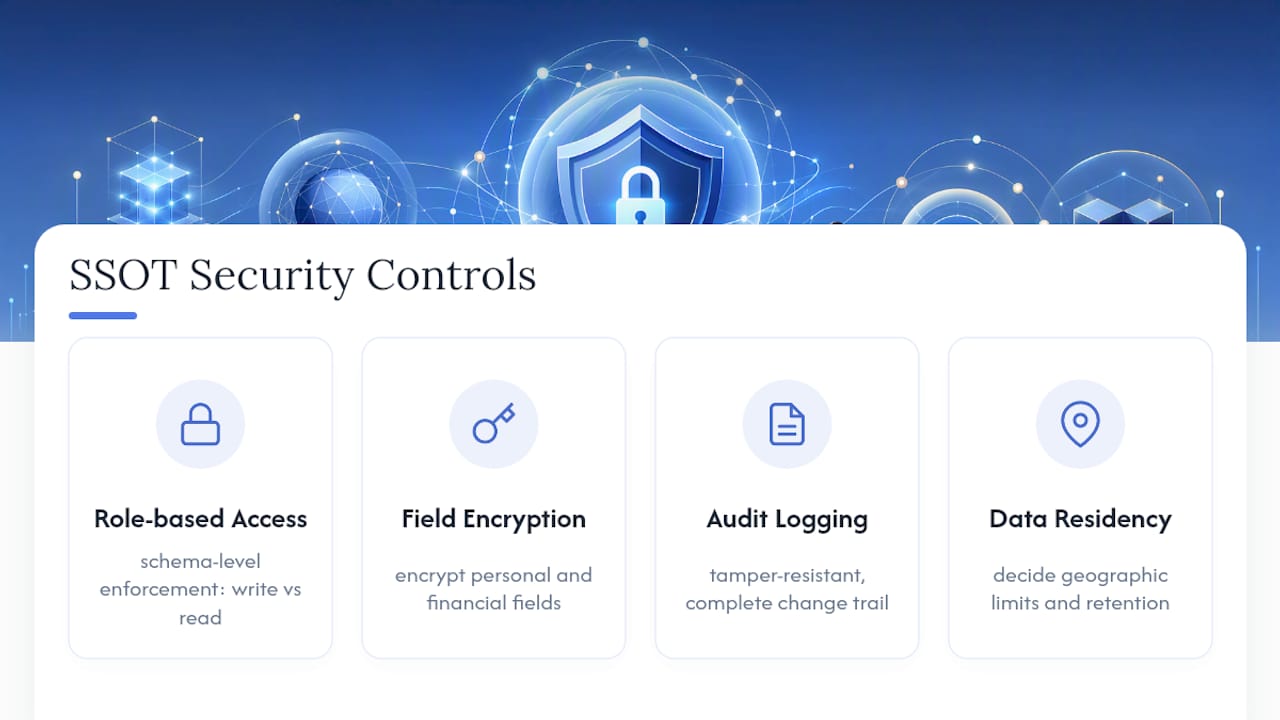
That means access control has to be more rigorous than it typically is for a scattered set of spreadsheets. Role-based permissions should distinguish between who can write to the canonical source and who can only read derived projections, and that distinction needs enforcing at the schema level, not just in application logic. Field-level encryption for personal or financial data within the canonical store matters more once that store is the definitive answer for every downstream system.
Audit logging becomes non-negotiable rather than a nice addition. If the SSOT is the authority everyone trusts, you need a complete, tamper-resistant record of who changed what and when, particularly for anything touched by data protection regulation. Event-sourced architectures have a natural advantage here because the audit trail is the architecture, not a bolt-on.
Data residency and retention policy also need deciding early, before the schema is finalised, because retrofitting regional data separation into a live canonical source is far harder than designing it in from the start. If personal data flows through your SSOT, decide at the schema design stage which fields need masking, tokenising, or geographic restriction, rather than discovering the requirement after the pilot has gone live.
Why culture, not code, decides whether SSOT sticks
Most SSOT failures aren't technical. They're organisational. A schema can be perfectly designed and still get bypassed within months if the teams who're supposed to feed it treat it as someone else's project rather than their own source of truth.
The resistance is predictable and usually reasonable: a sales team that's built years of process around its own CRM export won't hand over authority to a new canonical customer record without a genuine reason to trust it. That trust gets built through visible reliability early, not through a mandate from above. Pilot on a domain where the current pain is acute enough that the affected team wants the fix.
Change management for SSOT adoption works best when it's sequenced like a product rollout rather than announced as policy. Name the stewards publicly. Show the reconciliation dashboard to the teams whose data feeds it, so they see their own error rate improving. Make the canonical source easier to use than the workaround it's replacing, because if the old spreadsheet is still faster for someone's daily task, it stays in use regardless of what the architecture diagram says.

Leadership sponsorship matters here in a specific way: not just budget approval, but visibly using the canonical data themselves in meetings and decisions, so teams see that the new source is actually where the organisation is looking.
How Rockmountai approaches single source of truth projects
Every SSOT engagement typically starts with mapping existing systems before proposing anything. That discovery phase surfaces where duplication actually causes pain, which domain to pilot first, and whether a schema-first approach, an event store, or a lighter MDM pattern fits the client's scale.
The process includes designing the canonical schema collaboratively with internal teams, generating types and API contracts from it, and building integration pipelines around real workflows rather than generic templates. The final architecture is owned outright by the client once handed over, without ongoing dependency on external parties to keep it running. That's deliberate: an SSOT should outlive the engagement that built it.
— rocky
How Rockmountai can help you build one
External experts can fill the gap when the architecture and governance work is more than an internal team can absorb alongside existing workloads. Process automation audits identify where data actually fragments, followed by design and build of the canonical schema, integration pipelines, and reconciliation testing, resulting in a system handed over for full client ownership.
Close collaboration with internal teams from initial consultation through full handover is important because an SSOT that nobody internally understands tends to decay quickly. Whether the need is a customer master reconciled across CRM and billing, an event-sourced order system for auditability, or a schema-first pipeline to prevent frontend and backend type drift, the build is scoped to specific systems rather than a generic package. If you're weighing up whether a strict SSOT is feasible for your organisation or where to start, request an audit with Rockmountai and get a concrete answer before you commit engineering time to the wrong pattern.